- Diagnostic guide
- Range Repair
Are Viking Ranges Worth the Money? What Ownership Really Costs
- Filed
- Reading
- 5 minutes
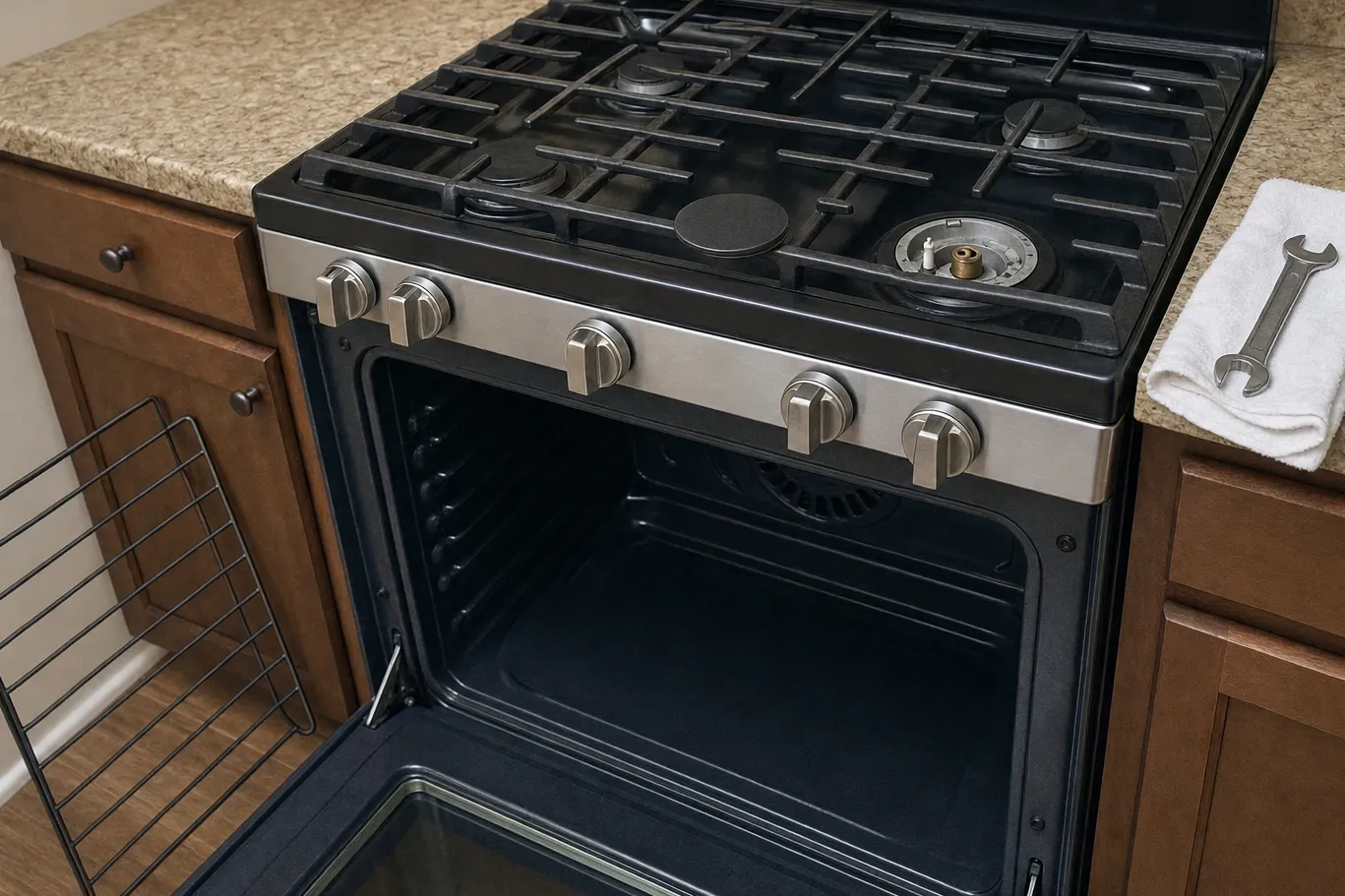
For most people who cook at home several nights a week, a Viking range is worth the money, mainly because it is built from separate, replaceable parts rather than as a sealed unit you throw away. When something fails, the usual fix is one component. A new igniter or burner assembly typically comes to $180–$480 and a comparable new Viking costs $6,940–$16,040. That gap is the real argument for owning one. It counts for even more in the older two-flats and bungalows around Logan Square and Portage Park, where kitchens tend to be narrow and pulling out a heavy range, then fitting another, disturbs cabinets, flooring and the gas connection.
What the price of a Viking range actually buys
Widths in the 5 Series freestanding family start at 30 inches and go up to 60. You pick the fuel: induction (VIR), electric (VER), dual fuel (VDR), or gas, where the VGR models have sealed burners and the VGIC models have open ones. Each sealed burner on the gas models puts out 15,000 BTU when it is fed natural gas, a figure that drops to 12,500 on propane. Select models trade the front-right spot for a TruPower Plus burner, good for 18,500 BTU from a natural gas line or 16,600 from propane. Inside the oven, a single U-shaped bake burner of 30,000 BTU shares the cavity with a Gourmet-Glo infrared broiler; SureSpark ignition fires each one, and the racks can sit in six places.
Those numbers translate into a hard sear, a fast boil on a big stockpot and a broiler that browns properly. If that is how you cook, the range earns its keep every week. If you mostly warm leftovers and bake now and then, much of that capacity sits idle, and a simpler range would serve you just as well. For a kitchen that only takes 30 inches, the 3 Series is built in that width alone, so a smaller room does not rule out the brand.
Why repairing usually beats buying again
The figures below are typical ranges for range and oven work. Your firm price comes after the fault is diagnosed, not before.
| Job | Typical range |
|---|---|
| Igniter or burner assembly | $180–$480 |
| Oven thermostat or heating element | $200–$440 |
| Control board or touch panel | $440–$690 |
| Comparable new Viking range | $6,940–$16,040 |
The diagnostic trip is billed at a flat $89 and that charge drops off your invoice if you then give the go-ahead for the repair. Even the costliest repair in the table is a modest share of what a new range costs.
A replacement also brings expenses that are not on the price tag. The metal anti-tip brackets packed with a 5 Series range have to be fitted when it goes in, and the installation manual says plainly not to throw them away. Wall cabinets directly above the cooktop must sit at least 42 inches over it unless a hood is installed. In an older kitchen, either rule can turn a simple swap into carpentry.
What pushes a Viking repair bill up or down
The part itself
Viking parts are matched to a series and fuel type, so a burner or igniter for an open-burner model is not the same piece as one for a sealed-burner model. Dual fuel and induction ranges carry more electronics, and those boards are the dearest single line in the table above.
Getting to it
A cooktop igniter is reached from above with the grate and cap lifted off. An oven bake burner, thermostat or element means opening up the oven cavity or the back panel, and a control board lives behind the control panel. If the range has to come out from the wall, the technician must release the anti-tip bracket and set it again afterwards, which adds time to the visit.
Finding the real fault
Two problems that look alike can have different causes. One burner that clicks but will not light is often a wet or dirty cap or a worn igniter, and our guide on a single burner that clicks without lighting walks through it. When no burner clicks at all, the trouble is more often something they share, such as the power supply or the spark module that feeds every igniter. Testing first means you pay for the part that actually failed, not the one somebody guessed at.
Working out what your own range is worth
Start with its age. Viking’s recall notices treat the opening six numbers of a serial as a date stamp, read month first, then day, then year; by that rule, serial 082421C10019872 was produced on August 24, 2021. A 5 Series can carry its rating plate in three possible places. Lift off the left-front grate and burner bowl and look on the left side panel below them; failing that, try the oven face frame below the controls, or the strip under the control panel right over the door. A 7 Series keeps its label behind the oven door, tucked up under the control panel, and a Tuscany dual fuel range carries its plate on an inner wall that only shows once the storage drawer is lifted out.
The model number tells you more. Read it left to right: base model first, two letters for the finish after that, and on gas units a closing tag naming the fuel. Viking’s own example, VGIC53024BWHLP, decodes as a VGIC53024B finished in white and configured for propane. A range set for propane cannot simply be hooked to a natural gas line. Changing the gas type is work for a qualified technician, and field conversion of a 5 Series to propane needs the optional kit LPKPDR01.
Coverage matters too. In years three through five, Viking supplies parts only, with you paying labor and shipping, on items such as gas burners (but not the ignition system, bases or caps) and electric elements. Our Viking range warranty guide sets out which part falls where.
If you are weighing a used range, its value rests on age, series, fuel type and whether every burner, the oven and the broiler work. A range with a known build date and nothing broken is worth far more to a buyer than one with a dead igniter.
When a Viking range stops being worth the money
Repair is not always the right call. If the oven body is rusting through, if two or three systems fail at the same time and the combined quote climbs toward the cost of new, or if parts for an older model are no longer made, replacement is the sensible choice. An honest diagnosis should say so plainly rather than sell a repair that will not last.
Getting a firm number for your range
Call (872) 204-0530 or use the booking button on this page. We work across Logan Square, Wicker Park, Avondale and Portage Park, and our Viking range repair service handles sealed-burner and open-burner ranges and rangetops. After diagnosis you get one price for the repair and decide from there.
Questions that follow this one
-
Is a Viking range worth the money?
For a household that cooks often, yes, because the burners and oven have serious output and nearly every part can be swapped on its own. A typical igniter or burner assembly repair runs $180–$480 against $6,940–$16,040 for a comparable new Viking, so a well-kept range keeps paying back what it cost.
-
Is an older Viking range worth repairing?
Usually it is, as long as the oven body is sound and parts are still made for that model. Read the build date from the first six digits of the serial number, then set the repair quote beside the price of new. One failed part is normally worth fixing; several failing together may not be.
-
What is a used Viking stove worth?
A used Viking is worth what its age, series, fuel type and condition support, and a working one is worth much more than one with a fault. Note the build date from the serial number and the model from the rating plate, and check that every burner, the oven and the broiler light before you price it.
-
What does it cost to have a technician look at my Viking range?
Expect a flat $89 for the visit and the diagnosis together; once you approve the work that charge is taken off the repair invoice. You get a firm price for the fix after the fault is found, so you decide before any part is ordered.
-
Does the Viking warranty still help in years three to five?
Partly: in that window Viking supplies certain parts, such as gas burners and electric elements, while you cover labor and shipping yourself. That parts-only burner cover excludes the ignition system as well as the bases and caps, so an igniter fault is usually paid in full.